
Research & Mission
The Artificial Intelligence and Machine Learning Core (AIC) at OMRF expands upon the Bioinformatics and Pathways Core to provide advanced AI/ML expertise and infrastructure. Our mission is to help COBRE Research Project Leaders (RPLs), Pilot Project Awardees, and the broader genomic regulation research community in Oklahoma adopt cutting-edge computational methods to advance their research and model diseases.
AI/ML – particularly transformer technology used in Large Language models such as ChatGPT -is reshaping biomedical research. To remain competitive in publishing and securing funding, investigators need access to specialized expertise and GPU-based infrastructure. The AIC provides this foundation while also developing novel analysis tools tailored to genomic regulation research.
Our current efforts include: 1) Building a genomic region embedding system, leveraging deep learning to capture spatial and sequence-based features of DNA beyond traditional statistical methods, 2) Developing Conditional Variational Autoencoders (CVAEs) to de-noise, normalize, and synthesize high-throughput experiments such as RNAseq into a compressed latent space that represents the most important features associated with specific conditions, and 3) Artificial Neural Nets (ANNs) to identify key features of importance on 2D signals, such as electroretinograms (ERGs) and nanopore sequencing data.
Services
We support investigators with a broad range of AI/ML applications, including:
- High-throughput data analysis: RNA-seq, methylation, ChIP/ATAC-seq, and multi-omics integration.
- Image & cytology analysis: Classifier development, segmentation, denoising, and quality control.
- Transcriptional network analysis: Differential expression, pathway enrichment, and cross-study meta-analysis.
- Large Language Models (LLMs): Applying transformers for text mining, metadata annotation, and workflow automation.
- Genomic region embedding: Deep-learning representations of genomic intervals to infer regulatory significance.
- GPU-enabled compute consulting: Access to and support for high-performance computing tailored to biomedical AI/ML workflows.
Personnel
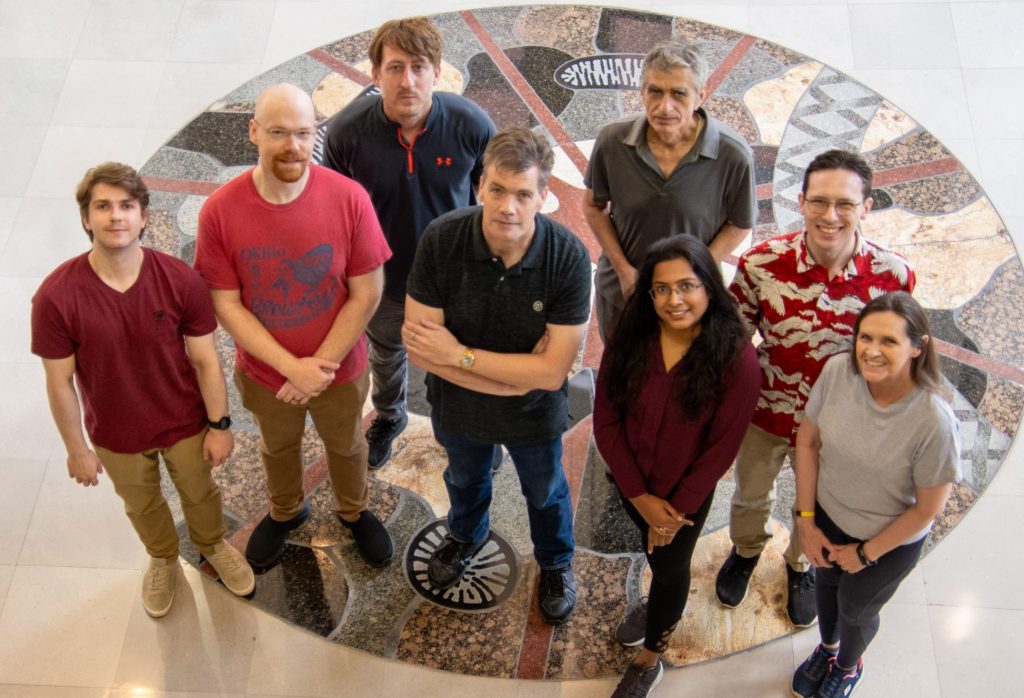
Jonathan D. Wren, Ph.D. – Director
With over 20 years in bioinformatics and 18 years at OMRF, Dr. Wren leads the AIC. He has authored 210+ peer-reviewed papers (H-index=61), served as Associate Editor for Bioinformatics for 20 years, and maintains a strong collaborative network. His expertise spans text mining, sequence analysis, machine learning, and data integration. He brings leadership experience as a PI and a background in business operations.
Cory Giles, Ph.D. – Bioinformatics Scientist
Dr. Giles specializes in AI/ML applications for genomics. He developed methods for GEO data meta-analysis, automated metadata annotation systems, and helped establish the first GPU cluster at OMRF. He has hands-on experience with large language models (e.g., LLaMA) for structuring experimental meta-data and convolutional neural networks (CNNs) for imaging.
Constantin Georgescu, Ph.D. – Bioinformatics Scientist
Dr. Georgescu earned his PhD in Statistics from the University of Illinois and trained as a postdoc in bioinformatics at Caltech. He has extensive expertise in sequencing data pipelines, particularly next-generation sequencing (NGS) and region-based analyses. He joined OMRF in 2014 and contributes deep statistical and computational expertise to genomic data interpretation.
Hunter Porter, Ph.D. – Postdoctoral Fellow
Dr. Porter’s research focuses on applying machine learning to model biological changes and evaluate potential treatments. He has developed expertise in epigenetic clocks using DNA methylation data, as well as in the analysis of genetic, epigenetic, proteomic, lipidomic, and metagenomic datasets. At OMRF, he collaborates widely to integrate big data with investigator-driven studies, with a particular interest in vision, neuroscience, and aging. His work bridges computational model development with translational applications, aiming to modernize experimental and clinical assays using deep learning.


